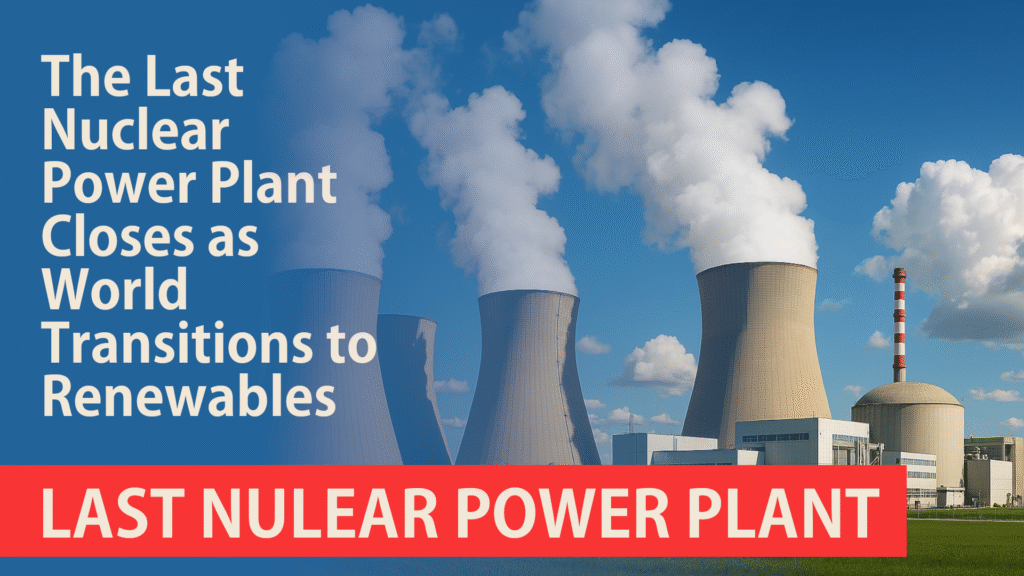
In a historic moment for the planet, the last operating nuclear power plant on Earth has officially shut down today, marking the end of an era in energy production. The Oak Ridge Nuclear Facility in Tennessee, United States, was the final bastion of nuclear power, after over a century of reliance on fission-based energy sources.
The plant, which has been a cornerstone of energy generation for the last five decades, closed its reactors at precisely 11:59 AM local time, sending the final electricity grid signal to the global network. The shutdown was celebrated as a triumph for sustainability, as the world now fully transitions to clean, renewable sources of energy.
A Clean Future Realized
The closure comes at the culmination of a decade-long transition toward sustainable energy. Over the past few years, solar, wind, geothermal, and tidal energy have rapidly advanced, filling the gap left by the declining reliance on fossil fuels and nuclear power. The International Energy Agency (IEA) reported that renewable sources now account for 100% of global electricity production, a feat that was once considered impossible by many energy experts.
Dr. Laura Kim, a leading renewable energy scientist, reflected on the momentous occasion. “We’ve worked for decades to get here,” she said. “It wasn’t just about technology. It was about policy, collaboration, and the will of millions of people around the world. Today, we’ve achieved what many thought was a distant dream.”
While the closing of the Oak Ridge facility marks a significant milestone, it also signals the end of a turbulent history for nuclear power, which has been both praised for its efficiency and criticized for its safety risks and environmental concerns.
The Nuclear Debate: A Legacy of Controversy
The Oak Ridge Nuclear Facility, once a symbol of energy innovation and power, now stands as a relic of the past. It was one of the last remaining plants following decades of plant closures around the world, starting with Germany’s phase-out in the early 2020s, followed by the U.K., Japan, and several others. Public opinion surrounding nuclear energy shifted dramatically after the disasters at Fukushima in 2011 and Chernobyl in 1986, and many countries decided to phase out the technology altogether.
Yet, proponents of nuclear energy have argued that it could serve as a bridge technology while the world developed better solutions for sustainable energy. Oak Ridge itself had undergone several upgrades and safety enhancements over the years, but its reliance on uranium fuel remained a contentious point in the global debate.
Nuclear critic Dr. Michael Armitage, who is part of the International Coalition for Clean Energy, shared his thoughts: “Today is the end of a dangerous chapter. We no longer need to gamble with the future of our planet by relying on an energy source that comes with both security and environmental risks. Renewables have proven to be safer, more reliable, and scalable.”
However, some former supporters of nuclear energy, like Dr. Henry Phillips, a nuclear physicist and policy advisor, expressed a different sentiment. “Nuclear energy was always the stepping stone toward a low-carbon world,” he said in a recent interview. “It was never meant to be a permanent solution. But its phase-out leaves a gap in terms of energy storage and baseload power that we still need to address with renewables.”
The Role of Renewables in the Transition
Global leaders have acknowledged the critical role of advanced storage technologies in supporting the transition to renewables. Wind and solar, while abundant, are not always consistent. Innovations in battery technology, including the rise of next-gen lithium-sulfur and quantum batteries, have helped stabilize the grid.
The International Renewable Energy Alliance (IREA) praised the technological breakthroughs in energy storage and grid management that made this historic day possible. “Storage was the final piece of the puzzle,” said Dr. Naomi Alvarado, head of IREA. “We can now store electricity generated by renewables for use during periods of low production. This allows us to supply reliable energy around the clock.”
Global Energy Equity
One of the most significant aspects of this transition is its inclusivity. For the first time in history, energy poverty has seen a dramatic decrease, with decentralized solar grids and wind farms providing reliable electricity to rural and underserved areas. Africa, once plagued by energy scarcity, has seen major strides in energy independence, with nations like Kenya, Egypt, and Nigeria becoming leaders in solar power generation.
“We’ve given millions of people the opportunity to live better lives,” said Adeola Adebayo, an energy advocate and researcher. “Access to electricity isn’t just about light; it’s about healthcare, education, and economic growth. This new energy system is more equitable than anything we’ve seen before.”
A Look Ahead
As the final reactor shuts down and the Oak Ridge facility becomes a part of history, the world has already set its sights on the next phase of energy innovation. New technologies such as fusion energy, advanced quantum computing in grid management, and artificial intelligence-driven energy optimization are all on the horizon.
“We’ve taken the first step toward a truly sustainable, green future,” said United Nations Secretary-General Maria Ramos in a statement issued after the shutdown. “The real work now begins in ensuring that we continue to innovate, preserve our environment, and empower future generations.”
For now, though, the world celebrates this monumental achievement—the end of nuclear energy’s era—and the dawn of a new age powered entirely by the sun, the wind, and the tides.
As the lights continue to shine brightly across the globe, it seems clear: the future is renewable.